
Rat Information
Here you will find a collection of articles about rat care, handy tips, and general information about pet rats.
All articles Copyright Robyn Arthur, 2002-2006.
- Spare Cage - how to make a cheap, simple spare cage for travel, vet visits, quarantine, etc.
- Free ranging rats - tips to prevent problems when free ranging your rats.
- Cool rats - effective and fun ways to keep rats cool in the heat of summer.
- Warm rats - how to keep your rats warm during winter's chill.
- Litter training - Yes! You can train your rat to use a litter tray!
- Our rat diet - what we feed our boys to give you some ideas for feeding yours.
- Care of older rats - some tips to help your rats enjoy their old age.
- Introductions - some tips for introducing rats to new companions.
- Rat bathing - do rats need it? And some tips to help the ordeal go smoothly for both of you.
- The Art of Scritching - some techniques for sending your rat into a state of eye boggling bliss.
- Claw clipping - some tips to help the ordeal go smoothly for both of you.
- Itchy rat - a step-by-step guide to determing the cause of and treating an itchy rat.
- The Rat Diary - a handy way to keep track of your rats' information, health and happiness.
- Fuzzlet World - a simple and fun way to get to know your new rats!
- What Rat Is That? - a photographic guide to the colours and markings of Australian pet rats.
Spare Cage
It is always a good idea to have a spare cage on hand just in case... just in case one rat is sick and needs a hospital tank, or needs to be fed medications away from the other rats. Or if you get a new little one who needs quarantining, or even if you're traveling with your rats. "But cages are expensive!" I hear you say. Well... here is a great spare cage you can make for about AUD$10 (US$6).
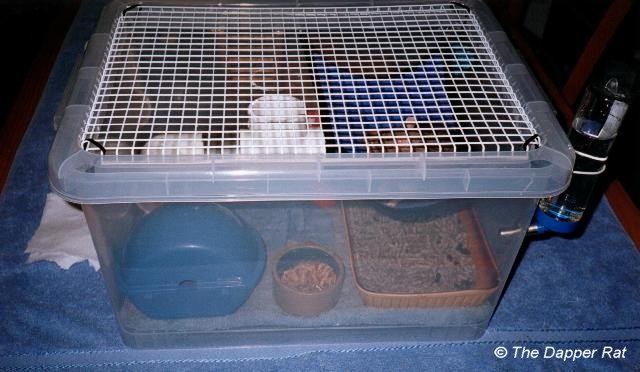
- Go to your local discount department store, like K-mart or Target.
- Find a transparent plastic tub, the type with the clip-on lids. You can pick up a 25 litre one for under AUD$10.
- Cut the flat bit of the lid out, leaving a 1/2 inch edge around the sides. You can do this by drilling four large holes in each corner and inserting a hacksaw to cut it out. Smooth any sharp edges with a file.
- Cut a piece of wire mesh to fit inside the lid so it overlaps the 1/2 inch edges. You can buy wire mesh for only a few dollars from a hardware store.
- Drill two small holes in each corner of the lid and use cable ties or twisted wire to hold the wire mesh in place.
- Attach a water bottle. Drill a hole for the nozzle to poke through and use stick-on velcro to attach the bottle to the outside of the tank, or hang it inside from the wire lid.
- Velcro on a flat backed plastic parrot feeder inside the cage so that the food bowl isn't tossed around in transit.
- Make it comfy and homey. You can drill 4 small holes and string up a hammock (or use suction cup hooks), or add a shoe box as a handy nest box and shelf in one.
And there you have it... a simple cheap spare cage.
Note: These tubs are also good to have on hand if your need to evacuate your home in an emergency, especially if your rat cages are rather large and cumbersome. Ensure you have enough to house all your rats in same sex groups. They stack easily so don't take up much room.
Free ranging rats
There's not many things more enjoyable than letting your rats free range. Watching them leap and zoom about in excitement, explore dark corners, and sleep in a comfy spot of their choice makes a little bit of effort on your part so worthwhile.
Before letting your rats free range you need to rat proof the area. Obviously the most important thing is to prevent danger to your rats from electrical cords, escape routes and other dangers, etc. Secondly, reducing the potential for other trouble such a chewing, or climbing to places where they shouldn't go.
Some ideas for electrical cords:
- Remove any cords that are not necessary.
- Remove cords from the rat's path. Rats will tend to run along the walls and lurk in corners, and will chew what they feel is "in their way". You can either re-direct the cords, or tape them to the wall high enough to be out of rat reach. There's stick-on clips available specifically for this purpose (e.g. 3M Cord Clips).
- Cover any exposed cords in a split piece of garden hose.
- Block off an area of the room that contains electrical cords using a barrier - See The Rat Run for how to make a simple home made cardboard barrier.
- Install an electrical safety cut-out switch, just in case.
Some ideas for blocking escape routes:
- Strategically placed bricks, pieces of wood or furniture can prevent your rat from getting into small places s/he shouldn't go, like behind the tv unit or under the sofa.
- A sheet of masonite or plexiglas makes a handy "gate" to block off a doorway to keep rats in, while still permitting you access by climbing over it.
- See The Rat Run for how to make a simple home made cardboard barrier to block off part of the room.
Preventing other dangers:
- Many houseplants are toxic to rats. Either remove them or ensure the rats cannot chew on them.
- Always be careful where you sit, especially if you have a rocking chair or sofa bed... rats love to explore dark hidden places.
- Remove shoes before walking in a rat zone and learn the "ratty shuffle" so you don't accidentally tread on anyone.
- Ensure all other household pets are locked elsewhere. No matter how much you trust them with the rats, instinct can overwhelm them and accidents can happen.
- Taping some cardboard so that it projects over the edge of bookshelves will prevent your rat from climbing up too high.
Some ideas for preventing chewing:
- Remove anything you don't want chewed or peed on.
- Provide lots of chew toys and fun things to keep your rat occupied while free ranging, to divert attention from your antique furniture. See Rat Toy Ideas.
- Consider trying some preventatives on problem spots, like bitter apple spray, ginger, tabasco or similar sauce.
- Cover problem chew spots (like skirting boards) with pieces of cardboard or lino.
- Double sided tape can also discourage chewing and climbing.
- Pieces of plastic carpet runner are handy for covering carpet in corners that rats like to graze on.
Some other ideas for preventing rat trouble:
- Litter training ASAP and provide a litter tray in the free range area. Details here.
- Provide food and water in their free range area if their cage isn't accessible to them.
- Teach your rat to come when s/he's called (have treats on hand).
- Large flat river rocks can be placed on top of the dirt in potted plants to discourage digging.
- Carpet runners placed upside down (bumps up) can make an area you don't want your rats to go significantly less fun to hang out on.
And remember: Rats will always be rats. Expect some damage and admire it for what it is: ratty artfulness.
With thanks to all on the ratlist who contributed to this article.
Cool Rats
Rats are particularly susceptible to heat and humidity and should be kept in conditions below about 25*C.
In hot weather, it's important to keep an eye on your rats for signs of heat stress. In particular, any of your rats who are overweight or sick as they will be more affected.
Some signs your rat is over-heated:
- Slowed movement, lethargy
- Apathy (even for treats)
- Tail, feet, ears and nose hot to touch
- Sprawled position, often with feet stretched out behind them (so they can lose heat through the soles of their feet)
- Mouth gaping open or panting
- Drooling
- Lying on their backs, feet in the air, mouth agape and not very responsive (dangerously hot!)
The best option for preventing overheating is to keep your rats in an air conditioned room. If this is not possible, you need to keep them cool in other ways.
Some ideas for keeping rats cool:
- Fill a spray can with water and wet the rats down (make sure you don't spray it in their eyes). Alternatively, wipe them down often with a wet sponge
- Drape a wet towel over part of their cage and provide a cooling fan or open window with a breeze.
- Bath them in cool water.
- Freeze a bottle of water, wrap it in a towel and place it in the cage for an instant cage air conditioner.
- Provide them with lots of cool water to prevent dehydration. Keep a spare bottle in the fridge and swap them regularly.
- Give them a terracotta pot. These make great sleeping areas in summer as they stay cool.
Fun treats/games to help cool them down:
- Fruitsicles - Cut up fruit or vegetable pieces and freeze. Good choices are watermelon, grapes, banana, honeydew, peas, corn, blueberries, etc. Ice cubes made of of fruit juice, or containing frozen peas are a welcome treat too.
- Wading pool - Use a heavy shallow food bowl (or a pot plant drip tray), fill with water and toss in a few ice cubes. The rats will sleep beside it to cool off, dangle their tails in the water, and lick the ice cubes.
- Ratty painting - Get a glass of cold water and a paint brush. Dip the paintbrush in the water and paint your ratty's hairless bits, especially tail and feet. This will help them cool off faster and give them a challenge (to grab the brush off you and rip it to pieces).
- Icehouse - Place their favourite nest box / loft / hammock in the fridge or freezer until it cools down.
- Fishing for peas. See details here.
Emergency options:
During heat waves of excessively high temperatures, or if you're unprepared with multiple frozen water bottles, or if you have a power outage and can't run your airconditioner or freezer, here's some emergency options:
- Take your rats to a friend's place where there is airconditioning.
- Place your rat cages in your airconditioned car and go for a drive.
- Go to your local service station / shop and buy a few bags of solid block ice. Wrap it in a towel and place it beside your cages. Replace as needed.
- First aid ice packs (the type that turn cold when triggered) are a handy back-up. Wrap in a towel and supervise so the rats don't chew on it.
Warm rats
In general rats best handle temperatures from ~10 - 25*C. Although they can cope with colder temperatures much better than hot. If it is cold in your rat room during winter, there's lots of ways to provide warmth for your rats in their cage:
- Polar fleece pocket hammocks are my boys' favourite winter haunts. They're warm, dark and comfy... the perfect place for a rat to while away a winter's day. You can see our pocket hammocks here.
- A nest box is essential in all rat cages... for warmth, darkness and privacy. For some great ideas for making nest boxes for your rats go here.
- Give your rats lots of paper towels in their nest box. They'll have fun shredding them and this creates a very warm and cosy environment.
- Provide your rats with lots of fabric strips ... old T-shirts, socks, fleecy off cuts, towels, etc. Apart from being fun to burrow in and build nests with, they also provide warmth.
- More rats! They can keep each other warm in big furry cuddling sleepy rat piles. (Sounds like as good a reason as any to succumb to New Rat Fever)
- A "warm buddy". Fill a bottle with warm water, wrap in a towel and place in your rat's cage. They can snuggle up next to it for warmth if they need to. This is also a handy method for keeping rats warm during illness or transportation.
- Warm foods... vegetable soup, mashed potato, warm creamed corn, warm milk, etc.
- Heating mat. If it's really cold during winter, you can provide a heating mat (ones used for reptile/fish tanks are good). Only use on the low setting and place it under only one end of the cage. That way the rats can move to a warm position that is just right and not overheat.
Wherever possible, try to keep the temperature in your rat room consistent. Large variations in temperature can stress your rats and make them more susceptible to illness.
Litter Training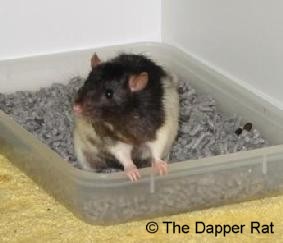
Rats are highly intelligent creatures and can be trained to do many simple tasks. Litter training is something that is well worth a little effort on your part, as it can save you lots of time in cleaning up and also money in buying bedding.
The whole training methodology works on the premise that rats are clean creatures and will go to the toilet where they smell that they, or other rats, have already gone. The procedure is as follows:
- Find the corner of the cage that your rats usually go to the toilet, then place a tray filled with litter there. I use flat tupperware containers available from discount stores for about AUD$2 as a litter tray.
- Toss in any raisins or wet litter you can find in the cage to make it smell like a rat toilet area.
- Now this is the most important part... Remove all litter from the rest of the cage, or use a different bedding. It's essential that your rats can distinguish between the toilet area and the living area. e.g. I use Breeders Choice recycled paper pellets in the litter tray, and old towels and fabric strips elsewhere as bedding.
- Place your rats in the tray to show them it's there. If they go elsewhere in their cage, say "No!" and place the rat (and the raisins) in the litter tray. If they go in the tray, praise them like crazy and give them their favourite treat. They'll soon get the idea.
Often this training method will only work for raisins, not pee... especially with male rats who are determined to keep their cage well scented. You can try removing pee smells by using products like Nilodor or vanilla, but often it just makes them more determined to re-scent it. Of course, there's also those stubborn rats who simply will not use a tray no matter how hard you try. Persist... after all, every raisin in the tray is one less you have to pick up later.
Litter training makes things so much easier on you. It's much simpler to clean out the cage (just scoop out soiled litter and replace as needed) and certainly cheaper. I think the rats much prefer the fabric and towels to live on anyway... it's less dusty, cleaner, softer on ratty feet, more fun to dig in and much quieter during those midnight skirmishes.
It's a good idea to have a litter tray for their use when outside their cage too... either as a separate play area tray, or simply access to their cage. When you get them out to play, place them in the tray so they know where it is. Every half hour or so, place them back in the tray to remind them it's there. If they use it, praise them like crazy and offer them treats.
Good luck!
Our rat diet
Note: I don't suggest that this is a nutritionally perfect rat diet... it's just what we feed our boys and hope it will provide ideas for some variety for your own rats.
Their dry mix:
This is available to them at all times. I also add some soy-based organic rat blocks to the bowl when I dish it out.
- 1 box of Dr Harry's (Lovatts) Pet Rat & Mouse Mix (available at most large supermarkets)
- 2 cups rolled oats (occasionally rolled triticale and/or barley)
- 1/2 box of Just Right Tropical breakfast cereal (varied occasionally to other Just Right flavours, or other low fat mixed grain cereals)
- 1/3 box of Uncle Toby's OTs Vanilla Crispy O's
- Handful of sunflower seeds
Breakfast:
One piece of fruit... watermelon, rockmelon, honeydew, banana, grapes, blueberries, pears, apple, strawberries, peaches, pretty much anything here.
A small bowl of yogurt - they love Fruche the best.
And one of the following (depending on what I'm having):
- bread or pikelet with a little omega ultra (EFA) margarine and jam on it
- weetbix in milk
- porridge
Their fresh dinner mix:
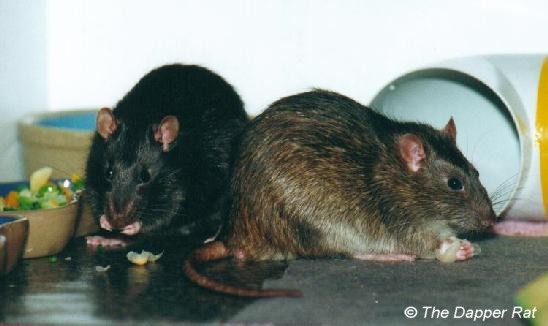
This is what they get at evening dinner time. I vary the mix each batch so the boys don't get bored.
- I/2 packet of wholewheat pasta spirals or macaroni, cooked
- 2 cups of cooked brown rice (or occasionally cooked wholewheat grains)
- 1 can of chickpeas (or occasionally lentils)
- 1 can of mixed beans (red kidney, soy, butter beans, etc)
- 1 large packet of frozen peas
- 1 small packet of frozen corn
- 1 packet of frozen broad beans (or frozen green soy beans if you can find them!)
- 1/2 packet of frozen broccoli, chopped
- 1/4 small pumpkin, chopped into small pieces and cooked
- 1 sweet potato, chopped in small pieces and cooked
- Any other vegies I have on hand that will freeze OK... like potato, carrot (if your rats will eat it, ours won't!)
This makes a large amount that I mix together and freeze in a tupperware container. Important tip: loosen the mix with a spoon repeatedly as it freezes, so it doesn't end up as a large solid block. Then it's as simple as scooping a portion into a microwave cup and cooking/defrosting for 2 minutes before serving. Although it seems like a lot of work to prepare, it only takes 30 minutes or so once a month, and 2 minutes a night to put it in a food dish. Everyone, rat and human alike, seems happy with this feeding arrangement.
I also add a special treat to the top of it each night, like a small piece of ham, chicken, oyster, fish, tofu, or something we might be having for dinner. Of course, they all eat straight off our dinner plate too. I offer them a fresh raw vegie each night too, like broccoli, kale, cauliflower, spinach, edamame, corn on the cob, etc... these are foods they prefer raw and this adds more variety to their fresh mix. It's important to offer as wide a variety of foods as possible to ensure they're getting sufficient nutrition.
General treats:
Treats to offer them occasionally:
- Uncle Toby's OTs Crunchy Squares
- Low fat muesli bars, chopped into pieces - they like the yogurt-topped ones!
- Yogurt drops - the human ones available from health food stores (Soland brand)
- Yogurt coated dried fruits
- Avocado - small cubes (avoid the area around the seed and just under the skin as it contains toxins)
- Sushi rolls - they're very fond of the avocado rolls, but also like the tuna and egg rolls.
- Creamed corn
- Cottage cheese / cream cheese (low fat Philly)
- Chocolate chips
- Anything we're eating
Chew treats:
These are offered to keep those sharp ratty teeth occupied and healthy:
- Chicken bones (cooked)
- Nuts in their shell (macadamias, pecans and hazelnuts are their favourites)
- Baby teething rusks (vegetable-flavoured)
- Dog biscuits (Eukanuba Restricted Calorie Rewards - low in protein and fat)
- Greenies (dog chew)
- Rat seed treat sticks
Caring for older rats
There are several special considerations that may need to be taken into account when you're dealing with an aging rat.
Inactivity
When rats get older, they do slow down and even normally active rats start spending more time sleeping and cuddling when out for exercise with their humans. This is the time you get the squishy cuddly lap rat you've always hoped for... enjoy these bonding moments with your furry old friend.
Reduced mobility
Older rats are prone to weakness caused by muscle wasting, degeneration of the spinal cord, pituitary adenoma or stroke. More information here: Weakness in older rats: A paralysis primer
Hind leg paralysis is quite common, particularly in male rats. Treatment with anti inflammatory drugs (like prednisone or metacam) or anabolic steroids (like laurabolin) can be of some assistance with this condition. But most paralysed rats get along amazingly well despite their disability.
Environment
An elderly rat will usually adapt just fine with some modifications to his environment. Be sure to make his home safe and easy for him to navigate. Some suggestions:
- Replace steep ladders with low, wide ramps with good grip (covering them with fabric or waterproof marine carpet can often help).
- Place food and water on each level of the cage so he doesn't need to travel far if hungry.
- Provide a hammock or soft bedding below shelves in case of a fall.
- Opt for a one level cage or aquarium.
- Cover any exposed wire... weaker rats are more likely to get their feet or claws caught in the wire.
- Lower his water bottle so he can reach it without standing up.
- Replace high hammocks with a floor level snuggle sack or nest box.
- Ensure his cagemates aren't bothering him... you may need to separate them if problems arise.
- Keep a consistent temperature range... older rats are more prone to respiratory problems and generally have less fat for warmth. A heating mat positioned under one end of his cage may be useful during winter.
- More regular cage cleaning is essential as an immobile rat may not be able to move away from soiled bedding, and may spill food and water.
- A change to fabric bedding can be helpful to prevent pieces of litter getting caught in an immobile rat's mouth or eyes, and it's also easier to move through.
Grooming
When rats get older, they can have some difficulty grooming sufficiently due to weakness. You may have to help him with this.
- A daily wipe down with a damp cloth or wet soft bristled brush can help keep his coat groomed.
- Rats use their feet to clean their ears, so you may need to remove built-up wax with a Q-tip once a week.
- Holding your rat upright in your lap can allow him to groom using both hands, something which is difficult with hind leg weakness.
- Regular clipping of his back claws will be necessary as they won't be worn down normally.
- Old immobile rats may start having bladder control problems. If this happens, wash his belly clean when he does wet himself, as the urine can burn and irritate the skin.
- Moving his limbs around with gentle range of motion exercises will help keep his joints flexible.
Diet
Old rats will not eat as much as they used to, so it's important that you provide them with highly nutritious foods.
- Extra high calorie treats are good to help keep muscle condition.
- Provide soft, pureed foods that don't require being held to eat, like baby food, pureed vegetables and fruits, rat blocks soaked in soy milk, "nutrical" high calorie paste, avocado, porridge, yogurt, etc.
- A vitamin and mineral supplement can ensure your rat is getting his complete nutritional requirements.
If your old rat is having trouble standing on his hind legs to eat, you may need to provide a low dish rather than a deep bowl for his food. Syringe feeding may be necessary when self feeding becomes difficult.
More information on feeding elderly rats here: Rat Nutrition
Health concerns
As rats age their immune system declines and they can become more prone to respiratory illnesses. They also take longer to recover from such ailments than younger rats. Other health issues associated with limited mobility include bladder infections, skin problems and fall injuries.
The sad farewell
We all wish our beloved old rats will pass away quietly in their sleep of extreme old age. However, there may come a time when you need to decide whether your old rat is still enjoying good quality of life. As difficult a decision as this may be for you, you should be prepared for this in advance. Contact a good rat vet in your area and ensure s/he uses a humane method of euthanasia and that you are permitted to be present during the procedure (if you wish). More information on humane euthanasia here: Humanely Euthanising Rats
Being prepared in advance will ensure you and your rat get through this emotional time without additional stress.
For more information, see these articles:
Introductions
Before you consider introductions... have you quarantined your new rat? Details here: Quarantine
There are times when you need to introduce a new rat to your existing group.. whether it's ratlets, an older rat, or even cagemates that have been separated for a time. Adding a new rat to an established group can sometimes cause problems as the new rat finds it's place in the social structure.
Any new rat arriving is going to be investigated by all the residents... whether that be a half-hearted butt sniff, a power groom or an outright attack from the alpha. But there are ways to help the introduction process go smoothly, as outlined in the following articles:
Even following these guidelines, you should still expect some amount of scuffling during introductions: squeaking, chasing, nipping, power grooming (where one rat pins the other down and grooms his belly or sniffs his butt), standing up and staring at each other, boxing, etc. As long as no one gets seriously hurt (i.e. blood) then it's better to leave them to sort out their social structure. Soon enough they'll be curled up together in the communal hammock.
Watch out for the signs of serious aggression: puffed up fur, sidling up to the other rat (to appear larger), biting and hissing. Also look for signs that the new or submissive rat might be scared or being injured, like screeching or screaming and cowering. If this happens, have a towel ready to throw on top of them, some heavy work gloves, or a piece of cardboard or book to separate them. Don't get yourself bitten by accident.
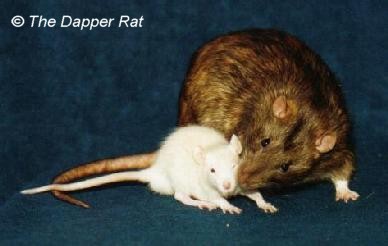
For your best chance of acceptance into an established group (or to an old lonely rat), consider adding several young rats (6-10 weeks of age). This is recommended for several reasons:
- The older rats will not consider them a threat to their dominance
- The ratlets will enjoy their rampant youthful play with each other rather than annoying the older lazier rats too much
- The alpha rat is less likely to pick on just one of them
- Once your old rats pass on the babies will grow up together and you're not left with another introduction process.
Keep in mind that, like humans, rats have personality clashes and some rats will simply not get along together. If despite trying all these tips your introductions don't go well, you may need to consider keeping those rats in separate cages.
Rat Bathing
Do rats need to be bathed regularly?
Rats don't actually need baths as they groom pretty much all day to keep themselves clean. But there are times you might need to bath them, like:
- If they get something yucky on their fur you'd rather they didn't groom off and ingest
- If they like to marinate in pee soaked bedding and end up stinky
- If it's for medical treatment, like a bath for a skin condition or to treat for parasites
- In preparation for a rat show
- If they are overcome by "buck grease" i.e. that orangey - oily male hormonal skin discharge
- If they are old or incapacitated and aren't grooming themselves sufficiently
- If it's really hot and you need to cool them down
- If they actually enjoy it... believe me, there are actually some rats who do love baths
How to bathe a rat
There's lots of different methods for bathing rats, and you need to work with your rat's personality to find out which works best for them. Here's what I do:
- Prepare the area:
- Fill the sink with warm water - a little hotter than you think, rats have higher body temperatures that us.
- Clear the bench of any clutter and place down a towel for the rat to stand on when wet.
- Have shampoo open and ready - a mild small animal shampoo (we use Epi-Soothe oatmeal shampoo)
- Have a dry towel or two within reach
- Perhaps also a bristle brush for grooming
-
Don protective clothing. You will get wet and probably scratched inadvertently. I actually prefer to bathe my rats without wearing long sleeves as this makes it a little less easy for them to climb your arms and cling wetly to your neck.
-
Grab unsuspecting rat and quickly dunk him up to the neck in the water, holding him there until he is wet through. Ensure you keep his head and ears free of water. Let him leap out of the sink onto the towel on the bench, he will probably shake and spray you with water. Placate him with soothing words of love... he won't believe a word of it, but it makes you feel not quite so mean.
-
Using a small amount of shampoo, lather your rat up using your nails to get down through to the base of the fur. This is also a handy time to clean his tail with a toothbrush (brush towards the tip). Your rat will either scream bloody murder at the indignity of this or squeak plaintively and shiver miserably while giving you the "Don't you love me anymore?" mope. Be strong.
-
Dunk your rat back into the water to remove all trace of the shampoo. Let him leap out onto the towel on the bench (he will probably shake and spray you with water again).
-
Bundle him up in a dry towel and rub rub rub... he'll like this part. A groom with a bristled brush helps to smooth and separate the wet fur and thus dry his coat faster naturally. If it's a cold day, ensure you dry him completely so he doesn't get chilled afterwards. Perhaps use a hairdryer on low setting if he'll tolerate it, or place him in a warm room to dry naturally.
-
Offer copious treats, which he'll take willingly and eat while glaring at you. Forgiveness will come with time.
Contrary to this, some rats do actually enjoy a bath and will swim about in the sink. In fact, it gets easier each time as your rat learns it's not actually going to kill him after all.
Some more bathing tips:
- Work fast - the quicker the less stress involved for you and your rat.
- It's important not to bathe your rat with shampoo too often as it can remove the natural skin oils, resulting in dry itchy skin. Bathe as often as necessary with water only, and use a mild, natural shampoo only sparingly.
- Speak calmly, soothingly and encouragingly to your rat during the whole process.
- Consider clipping your rats claws a day before the bath... it may save your arms from serious injury. See Claw Clipping below.
- Expect some madness in the cage post bath, especially from your alpha rat. When the shampoo/clean smell takes over from rat smell, your alpha may feel the need to reassert himself by rubbing against and peeing on everything, puffing menacingly, hopping about madly and grooming everyone.
The Art of Scritching
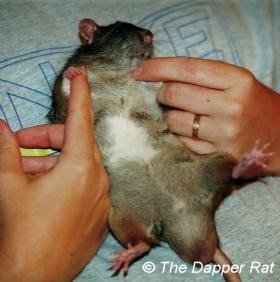 Scritching is the collective term for petting, rubbing, massaging, scratching, kissing, cuddling, grooming, fondling, tickling and otherwise showing your rat just how much you love him/her.
Some rats will happily relax for hours at the mercy of your hands, bruxing their little furry hearts out in delight or falling asleep peacefully in your lap. But don't be upset if your rat won't endure extensive scritching sessions... specifically girls and young rats, who typically are constantly on the go, having things to do, places to see, stuff to chew, etc. But they'll still enjoy a quick scritch before powering off, and will most likely be more amenable to long scritching sessions as they mellow with age.
Here's some tried and true techniques for sending your rats into a state of eye boggling bliss:
Massaging:
- Grab a handful of your rat's loose skin (best on the back and sides) and rub firmly between your fingers in a back and forth motion.
- Massage your rat all over his back with your fingers in a slow firm circular motion.
- Consider purchasing the book "The Tellington Touch" by Linda Tellington-Jones, which describes an holistic massage therapy for animals.
Scratching:
- Sit your rat on your lap so that he's facing you and seated on his butt, holding his body upright with your thumbs under his armpits. Using your fingernails, scratch firmly along each side of his spine, running up and down his back.
- Scratch your rat's butt, just above his tail. This makes my boys lick my hand. :)
- A single fingernail scratch just behind your rat's ear is a firm favourite.
- Many rats love a scratch on their cheek just behind where their mouth ends.
- A fingernail scratch along your rat's furry sides is always welcome.
- Some brazen hussy girl rats will press themselves against the cage bars so that you can scratch their whole bellies through the bars.
- Try a good firm scratch on the shoulder blades, just above where the front leg attaches to the body.
Rubbing:
- Favourite rubbing locations include around the ears, head and butt.
- Place your rat on the floor/sofa/table in front of you, and place your palms along each of his sides. Then move your hands up and down quickly, like you're chaffing him to warm him up on a cold day.
- Try a firm circular motion with your fingers, getting right down to the skin and mussing the fur.
Stroking:
- Many rats love a long slow stroke from nose tip to tail tip.
- When rats are sleepy, they often enjoy a soft slow smoothing of the fur on their face, whisker area and head. Use the soft pad of your thumb for best results.
- "Velcro" your rat to your chest (i.e. let him cling to your chest) while you rapidly and firmly stroke him from head to butt with your whole hand, one hand after the other.
- A backwards stroke from butt to head, firm and against the fur growth, is loved by many rats.
- A grooming with a soft bristled brush, firm so it gets right down through the coat, is a great way to scritch your rat and keep his coat looking spiffy at the same time.
Tickling:
- Flip your rat over so he's sitting on his butt in your lap, facing away from you, hold him upright with your thumbs under his armpits. Now tickle his belly, chest and under chin area with your fingers. This should be combined with much giggling and cheerful smoochy baby talk.
- A quick light pinch on your rat's butt will send him bouncing off playfully during free range time.
- Lie your rat upside down on a soft cushion/pillow/bed, place your hands either side of his body and then roll him lightly from side to side. This should be combined with much belly kissing for best effect.
- Hold your hand palm up and, with fingers tickling madly, advanced the hand under your rat from the front. You will end up with a rat on your hand, squirming cheerfully as you're tickling his chest and belly.
Kissing:
- Rats love belly kisses and raspberries... and even if they don't we love giving these to them. :)
- A soft kiss on top of a furry ratty head is often appreciated.
- Many rats enjoy a kiss on their whiskery noses and will reciprocate with a lick on your lips or nose.
Remember that all rats are individuals and what one likes, another may not. You need to try each of these techniques (and any others you can think of!) out on your rats to find which one/s hit the spot. Ratties everywhere enjoy!
With thanks to the ratlist for inspiration and contributions from Missy, Moca and Claire.
Claw clipping
Rat claws are designed for digging and climbing and thus are naturally long and sharp. This is great for a wild rat, but not so good if you like cuddling with your favourite pet. Rat claws, like human fingernails, grow continuously during their lives. Usually they are kept short by normal wearing away on abrasive surfaces like rocks, branches, digging in soil, etc. As these are often not available to a pet rat, claw clipping is an option you may choose to do regularly.
Is it necessary?
Claw clipping is not essential, unless the claws grow so long that they are causing trouble for the rat (e.g. getting caught in cage wire and torn out, or causing cuts on their skin during normal grooming). It's also wise to clip your rat's claws during treatment for external parasites, as this can prevent skin injury during excessive scratching. But, usually we choose to clip their claws to prevent us from getting scratched when they play on us... human skin has poor traction.
How often?
As to how often to clip them... well, that will depend a lot on the rat's environment. If they have lots of rough things to climb on
(branches, rocks, brick under their water bottle, etc.) then they will keep the claws down continually and you may never need to
clip them yourself (see Prevention below). On the other hand, if they wallow in the plush luxury of fabric strips and soft hammocks you may have to clip their claws every few weeks. If you have an allergy to rat scratches, regular claw clipping is essential.
How do you do it?
There's many techniques to choose from, depending on the personality of your rat. I use a regular small human nail clipper. We use two big strong people for one itty bitty little ratty. One holds the rat's body still, the other holds the foot and does the clipping. It helps to bundle the rat up in a towel if you have a particularly squirmy and/or troublesome rat. Others have had better luck by placing the rat on a shoulder, so that their toes splay out while trying to grip, and distracting the rat with a yogurt drop. If you're doing this alone, try placing your rat's nose in your elbow, holding him in place with your forearm and stretching his foot out behind him to clip the claws. See what works best for your rat, but keep a few of these tips in mind:
- Choose a time when your rat is sleepy/lazy, like after dinner or play time. If he squirms and complains a lot, give him a break and try again later.
- Be fast... the shorter the ordeal, the better for both of you.
- Make it a calm experience... talk soothingly to your rat, scritch him, give him a cuddle break between feet, etc.
- Lots of praise and a treat immediately afterwards reinforces the clipping as a positive experience.
Just take the very sharp tip off the claw, being sure not to cut too far down to the quick (red bit in centre of nail) as this can bleed
profusely. Have some corn flour or styptic powder on hand to dip the claw in to stem the blood flow, just in case.
It does get easier each time you clip your rat's claws, as you become more proficient and your rat realises it's not all that bad after all.
Prevention:
To keep your rat's claws down continuously, you can try some preventative measures. Place a rough brick in their cage, preferably somewhere they have to go a lot, like under the water bottle. Other options are including a rock in their cage (perhaps as a step to a higher shelf), a climbing branch, or offer them an occasional digging box, etc.
Itchy rat
There's quite a few excellent articles on the internet that provide information on treatment of specific skin problems in rats (relevant links are included below). But more often than not, you're uncertain as to exactly what's causing the problem. This article provides a step-by-step guide to dealing with an itchy rat when you're uncertain of the cause. If at any time you're unsure of your diagnosis or treatment, or if the skin problem is causing your rat excessive stress, you should consult a qualified vet.
Itching and/or scabs (and often resulting hair loss) is the most common skin problem in rats. This can be caused by a number of factors:
- External parasites - lice, mites and fleas
- Diet - excess protein, lack of essential fatty acids, food allergies
- Contact allergies - to bedding, cleaning products, etc.
- Injuries - from long claws, barbering, fights with cagemates
- Dry skin and dandruff
- Skin infections - bacterial, fungal, etc.
However, it's often difficult to determine which of these is causing your rat's problem (it may even be several of them). So here's a step-by-step plan of action for treatment of scabs and itching in rats:
1. Examination
Skin problems in rats are quite common, so you should inspect your rat's skin regularly. Some things you might find and what they indicate:
- Bugs moving about, or their eggs attached to the base of hairs - parasite infestation
- Scabs, cuts or other sores
- Excessive itching
- Hair loss
- Dandruff and dry skin - dry air in your rat's living area, over bathing, lack of EFAs in your rat's diet
- Rash, lesions, redness, offensive smell, skin infection, etc. - consult a vet for examination and treatment
- Orange oily discharge and/or dandruff - this is normal for hormonal males and is not a medical concern
Obviously if you see parasites, you've found the main cause of your rat's itching. But scabs, itching and hair loss alone are non-specific signs. If you don't find any particular reason for your rat's itching, then you need to work through the following steps to determine the cause.
2. Clip your rat's claws
If your rat has long, sharp claws, they can cause cuts and scratches to their skin during normal grooming. Likewise, if your rat is being barbered (over groomed) by a cagemate or fighting often, he may end up with scratches. In turn, the scratches will become inflamed and itchy, causing subsequent injury.
Clipping your rats claws regularly can prevent further injury. See Claw Clipping (previous article) for information and tips. You can apply antiseptic cream (preferably also containing anaesthetic) to any cuts to help with healing.
This may well solve your rat's itching problem, but if he continues to scratch then you need to move on to the next step. Even if it doesn't solve the problem, clipped claws will prevent further injury while you determine the underlying cause.
3. Treat for external parasites
Rats can get mites, lice and fleas, all of which can cause itching and scabs on the skin, particularly around the neck and shoulders. Information on identifying and treating these can be found here:
This is probably the most common reason for itching and scabs in rats. Don't rule out this possibility simply because:
(a) you can't see any bugs moving about - mites are tiny!
(b) you haven't introduced any new rats - parasites can arrive via contaminated bedding or food, wild rats having access to your rat's play area, or on your clothing after interaction with a friend's or pet shop's rats
(c) your other rats aren't scabby too - sometimes mites can overrun just one of your rats if his immune system is lowered.
It's often wise to treat for parasites before considering the other possible causes of itching and scabs. Determining dietary problems and allergies can take weeks of trial and error, while the possibility of parasites can be solved after one week of treatment.
No matter what the bugs are, ivermectin is usually prescribed. You can either take your rat to the vet for an injection (Ivomec), or better yet, dose him and all his cagemates orally with ivermectin yourself. You can get it from most pet or tack shops, sold as horse worming paste. [Equimec in Australia, Equimectrin in the U.S., active ingredient ivermectin - 18.7g/kg or 1.87%]. Adult rats (300-500g) get a small amount equivalent to a grain of uncooked rice. You should split the dose for younger rats, depending on their weight. Dose once a week, for at least 3 weeks. The paste isn't mixed well, and since you're giving such a small dose, it's safest to decant all the paste into a small container (like a film canister or baby food jar) and mix it well before taking the rat dose out.
I recommend Fido's Concentrate used along with ivermectin. Diluted to the strength used for birds, you can bathe your rat in it to kill the bugs and immediately ease itching while the ivermectin breaks the parasite life cycle. You can also make this up in a spray bottle for use in their cage and areas your rats are permitted in your home (carpet, furniture, etc), and add some when washing your rat's bedding. If Fido's is not available in your area, choose a lice spray containing pyrethrin (with no more than 0.15% pyrethrin)... one sold for birds is often a suitable concentration for rats.
Be sure to continue the complete 3 week ivermectin treatment as you still have to protect the rats from hatching eggs. You should strip down their cage and give it and any toys, hammocks, areas they play in, etc. a thorough disinfecting several times during the dosing. Also consider the possible sources of the bugs, like infested bedding and food, wild rat access to your pet's area, new rats introduced, cross contamination from your clothes, friends rats, pet shop, etc.
If your rat continues to scratch after one week, then the itching and scabs are probably not the result of parasites, so you should continue to the next step.
4. Consider your rat's diet
A diet too high in protein and fat can cause itching and scabs, in particular around the chin and face. Cut back on high fat and protein foods (like sunflower seeds, nuts, dairy products, meat scraps, etc.). Feed a balanced rat diet, like a rodent block and fresh vegetables and fruit. A vitamin supplement may also help. Information on a healthy rat diet here:
A diet deficient in the essential fatty acids can also cause scabs (often along with dry skin and dandruff). EFAs are found in oily fish, seeds like flax and sunflower, and nuts (walnuts and peanuts in particular). They can also be obtained by supplement.
Rats, like humans, can have food allergies. Some problem foods include dairy products, corn and soy proteins. You will need to use trial and error to determine which, if any, foods are causing the problem. Remove one food each week, recording your rat's diet and skin response in a diary. Food allergies are not common in rats, and determining the problem food can take a long time to figure out, so consider all the other possible causes of itching first.
5. Consider your rat's living environment
Although uncommon, rats can have allergic reactions (like contact dermatitis) to products used in their cage or living room. It would be unusual for your rat to suddenly start to react to the bedding he's been on for awhile, but if you have recently changed your brand of bedding, this may be the cause of his itching. If so, changing back to the previous bedding, or using fabric strips and paper towels for awhile, would be a good idea to see if this is the cause.
Likewise, consider any other new products you may be using in your rat's area... cage cleaning products, washing liquid, fabric softener, deodorant, even your own perfume, scented candles, etc. As with food allergies, remove one product each week and record your rat's response in a diary.
Rat skin can become dry and flaky, and subsequently itchy, if they are kept constantly in dry conditions such as air conditioning and central heating. If this becomes a problem you can provide a humidifier, keep a water spray bottle on hand to dampen the air and/or your rat, or bring your rats into the bathroom with you when you shower.
6. Still itching?
If your rat doesn't respond to any of these treatments, you may be dealing with a skin infection (such as a bacterial infection, ringworm or other fungal infection, excema, etc.). These are usually identified by redness, lesions or a rash and should be examined
(usually by skin scraping and microscopic examination) and treated by a qualified vet.
For more information, see Skin Problems.
The Rat Diary
No matter how many rats you have, it's always a good idea to keep a rat diary. This is for recording all kinds of information about your rats, from their birth dates to their health. Here's some of the information you might consider including in a rat diary.
General information:
- Your rats' birthdates - they only get a few birthdays, you wouldn't want to miss the party!
- Adoption dates for new rats, and quarantine procedures undertaken (if necessary).
- General care - the dates you last bathed them, clipped claws, cleaned tails, etc.
- Maintenance - major cage cleaning days, any new equipment or cleaning products used, etc.
- Purchases - note when you purchased medications and their expiry dates, new batches of bedding or food (handy to know if you get an unexpected parasite infestation).
- Rat weights - record the weight of all your rats every week. With ratlets it's handy to see if they're growing consistently. With older rats it can be an important indicator of health, as rats tend to hide illnesses very well and weight loss is often the first indicator of a problem.
Medical information:
- Signs of illness - note any signs that your rat is unwell. Include things like porphyrin, lethargy, breathing (noisy, laboured, rapid, etc), pain (hunched posture, squeaking, fluffed fur, etc), sneezing, wounds, accidents, etc. Obviously, consult a vet asap if the condition is serious.
- Well being - note anything you notice about your rats that is not normal. For example, one day Bramble looked "off", just quieter and not his usual cheerful self, two days later he developed an abscess in his belly. This kind of pre-information can be very helpful to your vet should your rat become sick.
- Vet visits - symptoms, name of vet seen, outcome of examination or tests, medications given, etc.
- Medications - drugs, dosages, and responses if your rat is sick.
Of course, this is just a start, include anything else you think might be useful. Your rat dairy serves as a record of all your rats' information, experiences and health care, and also as an archive of their weights and birthdays and other memorable moments from year to year. And take it along to your vet with you if your rat is sick... the information may be helpful to your vet.
Fuzzlet World
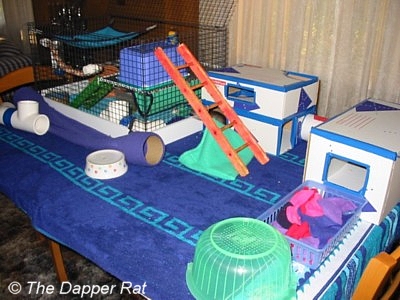 Whenever we bring new ratlets home, I put together what I call "Fuzzlet World". Basically just my dining table, covered in a beach towel, with their cage on it and some toys scattered about (as shown in the photo here). I've always found that this is the best way to socialise new rats, so you can get to know each other in a safe environment.
I will open their cage and sit at the table with them while I have lunch, or read a book, or do some work or whatever. Rats, being inquisitive, soon come out of their cage to see what I'm doing. Or at least watch me from their cage and get used to me being near them. I have lots of places on the table for them to hide in, or scurry between, or play with - a cardboard box clubhouse, a soft tunnel, PVC tubes, igloo, snuggle sack, etc. That way if they get a fright they have somewhere to hide, or they can go home to the safety of their cage.
The ratlets also seem to enjoy it when I lean my arms and head on the table and they get to explore my hair and face and down my shirt. It's a great way to get to know each other.
In this way you can easily interact with your new rats in a safe environment without fear of them escaping under heavy furniture or being too scared away from their cage. And they seem to gain confidence knowing they have the freedom to come and go from the cage as they please, rather than being picked up and taken out.
Here's some more articles with tips on socialising your new rats:
Even after they've moved into The Grotto (our big cage), I still give fuzzlets their play time on their table until they're more grown up and confident enough to free range on the floor. In this case, I just cover the table in toys, along with food and water and a litter tray, and let them run on there while I supervise (as shown in photo below). This can also be a handy option for letting your rats enjoy their daily time out of their cage if your home isn't suited to free ranging them on the floor.
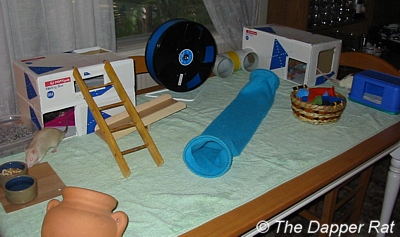
If you need ideas for toys to put in your Fuzzlet World, see Rat Toy Ideas for lots of easy home-made or cheap toys that your rats will love.
These articles by no means cover all aspects of rat care. If you require further information, see the Rat Care Links.
If you have further rat care questions, you can direct them to the Rat Info address ratinfo@yahoogroups.com, where informed volunteers will help you as soon as possible.